While learning C++, you will encounter different kinds of features of object-oriented programming. Among them, there is a very useful feature known as Inheritance. And the “Multiple Inheritance in C++” is one of the sub-branches of the category.
If you want to extensively work with the Class Concept in CPP, then you have to master the Inheritance, particularly in the Multiple Inheritance. AS in this concept, a Class can use the features of the other classes without declaring in that base class.
In this article, we will first look at the basics of the Inheritance. Later, we will move to the Multiple Inheritance and its implementation method. So, let us start our discussion.
Summary or Key Highlights:
- Inheritance in CPP is associated with the Object Oriented Programming Concept.
- In Multiple Inheritance, a base class can associate with two or more classes at the same time.
- The Base Class can acquire the functionalities of other classes without declaring.
- With Multiple Inheritance, some major problems can occur like the Diamond Problem.
- We can use the Constructor with the Multiple Inheritance in CPP.
What Is Inheritance In C++? Read Below
C++ is an object-oriented programming language. And every OOP programming language has inheritance as a core feature. Inheritance is a property that helps to acquire the features of the other classes into another class. It means, using inheritance, one class can able to use the functions of the other classes.
If a class derives the properties from another class, it will have the opportunity to use that function as per its need.
There are some naming processes are present. The class that uses properties of other classes is termed the “Child Class”. And the classes from where the properties are being used are termed the “Parent Classes”.
According to the need, the properties of the other class can be changed in the child class. There are lots of types present in the inheritance in C++.
What Are The Types Of Inheritance In C++?
There are five types of inheritance are present in C++. Among them, we intend to discuss multiple inheritance in C++. All the types of inheritances in C++ are the following ones:
- Single Inheritance: In this case, the class gets features from a single Base Class or Parent Class.
- Multiple Inheritance: In this case, the class gets features from two or more Parent or Base Classes.
- Multilevel Inheritance: In Multilevel Inheritance, a Normal Class gets a feature from a Parent Class, then the Normal Class becomes the Parent Class and starts sharing functions with another class.
- Hierarchical Inheritance: If the Child Classes creates the Hierarchical format, then the Hierarchical Inheritance can be seen. Here, a Single Parent Class is present.
- Hybrid Inheritance: If two or more above-mentioned inheritances are present in one code, then the inheritance will be known as the Hybrid Inheritance.
What Is Multiple Inheritance In C++? Get To Know
Now., it is time to know about multiple inheritance in C++. Here, it is not possible to look into each & every inheritance type in C++. As it is a type of inheritance, it will follow all the basic policies of inheritance. But here, as the name suggests it can inherit with more classes. That is why it is termed multiple inheritance. Here, it can extract the feature from the classes & use the combined feature in that class. Here, the pattern of the parent class matters.
In the inheritance, one particular operator is used. It is the colon operator (:). This colon operator after any class name is being used to indicate the inheritance. First, the child’s class name should be provided. Then, the parent class name is provided after the colon operator.
It means the first parent class in the sequence should be executed, then the other parent classes will execute one by one.
General Syntax: child-class-name: series of parent class names
How To Implement Multiple Inheritance In CPP?
We hope, till now whatever we have discussed should become clear for you. Now, it is time to implement the Multiple Inheritance in CPP. Here, we are going to take a simple example where the above-mentioned syntax will be used fully.
So, let us check the following C++ Code and understand the complete implementation process carefully.
#include
using namespace std;
class zapone{ // First Class
public:
zapone()
{
cout << "Hello ZapOne" << endl;
}}; // Function With Same Name
class codingzap{ // Second Function
public:
codingzap()
{
cout << "Hello CodingZap" << endl;
}}; // Function With Same Name
class program: public codingzap, public zapone{ // This Function Order Is Followed
public:
program()
{
cout << "This Is Multiple Inheritance" << endl;
}}; // Third Function With Same Name
int main()
{
program cpp; // Declaration Of The Child Function
return 0;
}
Steps Of The Program:
- Here, we have declared two classes. They are public classes.
- In each class, there is a function. Inside the function, we have written one print statement.
- Now, one thing is necessary while doing multiple inheritance in C++, the class name & the function name should be the same. If they are different, then it will not work.
- In the child class, after the name of the class, the colon operator is placed.
- Then after the colon operator, we provided the series of the parent class. This series will be followed.
- The first parent class function will be executed first. Then the second one will be executed.
- Now, we have to write the main function. Inside the main function, we need to declare the child class.
- We need to declare the child class with one variable. And the series provided there will be followed only.
Output:
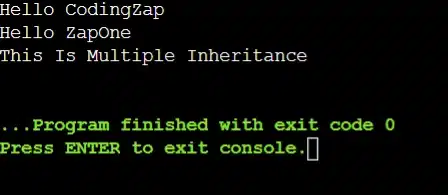
From the above output, we can see that the Statement inside the CodingZap Function and Class is coming first. Whereas the Statement of the ZapOne Function and Class coming next, this says the code is following the Parent Class Series. At the end, the Statement in the Child Coding Class will come.
What Is The Diamond Problem In CPP Multiple Inheritance?
We hope that the Simple Implementation of Multiple Inheritance becomes clear to you. Now, it is time to state one of the Major Challenges that you might face while working with the Multiple CPP Inheritance. This is known as the Diamond Problem.
The name Diamond Problem comes from its structure. You can check its structure in the following image. Here, four classes interlinked with each other making a diamond shape. That is why, such a name is given. Now, we will look into the problem reason.
From the image, we can see, that from Class A, two Child Classes Class B and Class C are derived. So, this is the Single Inheritance for both the Class B and Class C. The problem is created when Class D tries to access features from both Class B and Class C. Here, it creates the Diamond Problem.
For the Class D, there is the ambiguity problem. Here, Class D is confused as both Class B and Class C have similar kind of features. If such a Diamond Problem exists in the code, you are going to get the Error Message on the compiler.
How To Solve The Diamond Problem In CPP Multiple Inheritance?
Now, the concept of the Diamond Problem should become clear to you. If you are thinking that having errors as the outcome is the only fortune of the Diamond Problem, then you are thinking wrong. There is a trick present by which we can bypass the Errors or Diamond Problem.
This is known as the Virtual Inheritance. In this case, the Keyword Virtual should be used before inheriting the classes. If we use the Virtual Keyword, the one copy of the base class will go to the child class. Hence, there will be no errors. Let us check the following code to understand the concept.
#include
using namespace std;
class Zap { // Declaration Of Class A
public:
void print()
{
cout << "Diamond Problem Solved" << endl; // Printing The Statement
}};
class One : virtual public Zap {}; // Declaration Of Class B Inherited To Class A
class Coding : virtual public Zap {}; // Declaration Of Class C Inherited To Class A
class Cls : public One, public Coding {}; // Declaration Of Class D Inherited To Both Class B & Class C
int main() {
Cls zp; // Creating The Object For Class D
zp.print(); // Bypassing The Diamond Problem
return 0;
}
Steps Of The Program:
- At first, the Class Zap will be declared which is the Main Parent Class.
- Inside the Class Zap, we have given a statement and we will try to print the statement.
- Now, the Class One will be created which will derive functions from Class Zap. This is the Single Inheritance.
- After Class One, we will for the Class Coding which will also derive functions from Class Zap. This is also the Single Inheritance.
- Now, the Class D or Class Cls will be declared which will connect with the Class One and Class Coding. This is the Multiple Inheritance.
- For all of the Inheritance, we will use the Virtual Keyword.
- Now, in the Main Function, we will create an object for the Class Cls.
- With the Class Cls Object, we will use the function mentioned in the Class Zap to print the values.
Output:
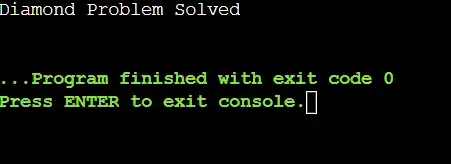
From the above code, we can see that the implementation of the Diamond Problem is done correctly. But still, we are getting the output in the compiler. That means the use of the Virtual Keyword is working fine. Hence, we can remove the Diamond Problem from the Multiple Inheritance.
How The Constructor Works With The CPP Multiple Inheritance?
Now, after the Diamond Problem, it is time to discuss some points related to the Constructor in Multiple Inheritance. You might know about the Constructor and Destructor in the CPP Language. When you create the Object, the Constructor will automatically create it there.
In the Multiple Inheritance, there is a simple pattern for the Constructors. The base class constructors will be called first in the series by which they are inherited. We can take one example to understand the complete process.
#include
using namespace std;
class Zap { // Declaration Of Class A With Public
public:
Zap()
{
cout << "Calling Class A Constructor" << endl; // Printing The Constructor Value
}};
class One { // Declaration Of Class B With Public
public:
One()
{
cout << "Calling Class B Constructor" << endl; // Printing The Constructor Value
}};
class Coding : public Zap, public One { // Declaration Of Class C With Public
public:
Coding()
{
cout << "Calling Class C Constructor" << endl; // Printing The Constructor Value
}};
int main()
{
Coding Cls; // Creating The Object
return 0;
}
Steps Of The Program:
- At first, the Class Zap will be declared which is one of the Parent Class. Inside that class in a function, we will use one Print Statement.
- Now, Class One will be declared which is another Parent Class. We will write another Print Statement in the declared function.
- Now, the Class Coding will be declared which will take the features of all classes. It will first inherit the Class Zap and later the Class One.
- In the Main Function, we will create the object of the Coding Class which will be enough to print the statements.
Output:
From the above output, we can see that the Print Statement of the Class Zap, Class One, and Class Coding are coming in the proper sequence. So, all the constructors are working fine. If we change the declaration order, there will be no issues. The major thing is the order of inheritance.
Difference Between Single and Multiple Inheritance In C++:
Let us find out some differences between Single and Multiple Inheritance in C++. Single inheritance is the most basic inheritance & multiple inheritance is the most complex one. So, the difference is essential.
Single Inheritance | Multiple Inheritance |
In Single Inheritance, the child class can derive the features from one parent class. | In Multiple Inheritance, the child class can derive the features from two or more parent classes. |
Here, the child class gets the feature of only one parent class. | Here, the child class gets the feature from one or more parents’ classes. |
It takes a small amount of time to run a program. | It takes a lot of time to execute a program. |
There should be one parent class name after the inheritance operator. | There should be two or more class names after the inheritance operator |
Single Inheritance helps to develop specialized C++ programs. | Multiple Inheritance helps to develop general C++ programs. |
Other than the C++ programming language, several programming languages use Single Inheritance. | Only the C++ programming language can execute Multiple Inheritance. |
The inheritance Tree is the result of using Single Inheritance. | Multiple Inheritance helps to develop the Directed Acyclic Graph (DAG). |
Conclusion:
As we saw “Multiple Inheritance in C++” is an important topic.
It is advised to clear the basics of the C++ programming languages. It will help to understand the topic more easily.
We should remember the difference between single and multiple inheritance in C++. It will help us a lot in the future. We have to practice more & more examples.
So, hope you have liked this piece of article. Share your thoughts in the comments section and let us know if we can improve more.
Domycodinghomework also offers a wide range of programming and coding help services for you to benefit from. Don’t miss out! Visit https://domycodinghomework.com/ and our expert team will be there to help you out.
Takeaways:
- Multiple Inheritance is a part of Inheritance that comes with Object Oriented Programming.
- If any class is getting features of two or more classes, Multiple Inheritance will occur.
- With Single and Multiple Inheritance, the Diamond Problem occurs which is a major challenge.
- To resolve the Diamond Problem, we have to use the Virtual Keyword for inheritance.
- The constructors are getting printed in the order of inheritance calling for Multiple Inheritance.


